Why UC Davis Losing their DI Varsity Equestrian Team is a Good Thing
So hot topic this week, but one that I think deserves a deeper conversation.
Check the volg out too!
Recently, UC Davis announced it was getting rid of its NCAA Division I Equestrian team and replacing it with an equestrian club, and many people are outraged. And while I do feel bad for the athletes, it's not the tragedy everyone is making it out to be. There are many reasons people are mad. I saw a TikTok that said the sport was growing, which is bull; it's shrinking because no one can afford it. Others have talked about the loss of opportunities the team provided, which, again, is BS because these teams are full of kids who have plenty of opportunity outside the UC Davis Team, and the team wasn't providing opportunity to kids who didn’t already have it. Now, there are always exceptions, but as a rule, UC Davis’ team wasn’t doing anything for equality, and the scrappy pony clubber who can't afford to ride at the “A” shows.
I know these are big claims, but I am probably as qualified as anyone to comment on this. In my college days, I was a Division II Rower. I am a lifelong equestrian, starting off riding in the pony divisions and then having a successful junior hunter/equitation career back in the 90’s, when you could still win a big class on an OTTB. I also now have time, age, and hindsight on my side to inform my opinions. From many of the comments I have seen, many people do not understand how the NCAA works or how exclusive and elite equestrian sports are.
I think there is a belief with some kids, the scrappy kids, the pony clubber types, that if they work hard, they can make a team, and they can later move into the upper levels of the sport. The reality is it's pay-to-play, and again, with few exceptions, there is no long-term opportunity for those who cannot pay.
I encourage comments on this post, as I would like to start a discussion that helps get DI equestrian teams and the sport in general to a point where they are sustainable, accessible, and showcase talent at a higher level of play. But I request that comments be constructive and factual.
The rest of this article will discuss the following three major points.
We will discuss why the UC Davis equestrian team and all other equestrian teams exist, focusing on Title IV's role in their formation.
Second, we’ll examine the skill level expected of equestrian athletes at the D1 level, compared with other NCAA varsity sports and their non-collegiate competition experience.
Address the lost-opportunities arguments, including the loss of scholarships, decreased access to equestrian sports, the loss of a professional pipeline into “equestrianism,” and concerns about athletes’ next steps after the program ends.
So first up, the reason there is an equestrian team at all is Title IX. Per the NCAA website linked here: https://www.ncaa.org/sports/2014/1/27/title-ix-frequently-asked-questions.aspx.
“Title IX of the Education Amendments Act of 1972 is a federal law that states: 'No person in the United States shall, on the basis of sex, be excluded from participation in, be denied the benefits of, or be subjected to discrimination under any education program or activity receiving Federal financial assistance."
And that
“Athletics programs are considered educational programs and activities. There are three basic parts of Title IX as it applies to athletics:
Participation: Title IX requires that women and men be provided equitable opportunities to participate in sports.
Scholarships: Title IX requires that female and male student-athletes receive athletics scholarship dollars proportional to their participation; and
Other benefits: Title IX requires the equal treatment of female and male student-athletes
And to comply with Title IX.
An institution must meet all of the following requirements:
Provide participation opportunities for women and men that are substantially proportionate to their respective rates of enrollment of full-time undergraduate students;
Demonstrate a history and continuing practice of program expansion for the underrepresented sex;
Fully and effectively accommodate the interests and abilities of the underrepresented sex;
And last: Title IX does not require reductions in opportunities for male student-athletes. One of the purposes is to create the same opportunity and quality of treatment for both female and male student-athletes.”
The result of Title IX was the creation of many “less popular sports” or sports that were more popular with women, becoming varsity collegiate sports, but only for women. In case you didn’t know, varsity equestrian teams are for women only; men can only compete on club or IEA teams. Horse sports are not the only teams where this happened. So, it is very likely, although I haven’t found proof, that the NCEA was created to help comply with Title 9 and, incidentally, provided UC Davis with the opportunity to ever have a team.
With the new government administration and the changes in DEI efforts, the interpretation of Title 9 is changing; and Ill admit, I originally thought that this might be a result of that, however, if I had to guess, it was more a numbers game, horses are expensive and a cheer team, or shout team or whatever it is that’s replacing the equestrian team with, is likely significantly less expensive and, has a bigger pool of athletes to pick from, especially from disadvantaged backgrounds, because it is more accessible.
This brings us to my second point: the level of skill required for equestrian athletes to compete at the NCAA D1 level is much lower than in other NCAA varsity sports. If you look at the level of play for other sports, many are preparing athletes to move into their sport at a professional level. In one TikTok clip I listened to, the person stated that college programs were a good funnel into horses as a career, and this argument is laughable. If you don’t believe me, go find videos online of NCEA competitions, I found a few and (comment below if you know better) the highest jumps look to be about 3’, MAYBE 3.3”. For comparison, the large pony hunters, a division largely for kids around the age of 10, is set at 2.9” – 3.0”. So, the NCEA/NCAA expects their D1 athletes, who are supposedly looking to move into the sport as professionals, to perform at a level that some grade school kids are competing at on ponies.
Now, just because the skill level to compete in the NCEA is low, it doesn’t mean that the riders competing in it aren’t more skilled, and based on the stats published, most riders are quite a bit more skilled. According to the Plaid Horse, all D1 Athletes in the signing class of 2024 attended an average of 21 shows a year, with many attending expensive, elite shows (66% attended medal finals at Harrisburg). The cost of these shows is extraordinary. They can be upwards of $10,000/show (but likely much more). I would like to note that show costs vary depending on your location, how far you have to travel, and other factors, such as whether you rent a horse for year-end finals. So, it could be less, it could be more, but I can't imagine, even if it were done cheaply, that anyone would spend less than $5,000 to attend any one of these shows. The fewest shows one rider attended was 7, which would likely rack up a bill of at least $7,000/year if they were all local, smaller, and maybe unrated shows. The most popular division for these riders was the large junior hunters, which now have two divisions competing at either the 3.3” or the 3.6” (it used to only be the 3.6” only, but apparently that’s changed).
Source from Plaid Horse: https://www.facebook.com/photo/?fbid=790532356426572&set=a.238056661674147
If you look at the resumes of these athletes competing on these teams, there is no doubt that they are good riders, having ridden at the top age-group levels in hunters and equitation. Also, it shouldn’t be overlooked that there are significantly fewer athletes whose experience is listed in the jumper ring. I would bet the kids riding in the jumpers are likely jumping higher and weren’t really interested in riding in the college programs. more skilled. Another issue I have, especially if these kids are planning to go pro, is that instead of starting in pro/open classes, competing over higher jumps, and building their careers, they ride in amateur divisions because college sports are “amateur” sports. Calling college sports “amateur sports” is a load of shit, but that’s a different conversation.
After seeing the data published by the Plaid Horse, I would love to know how many collegiate riders get to compete at elite shows at Thermal, WEC, and WEF in FL. I did some googling and have seen a few young riders with YouTube channels on NCEA teams down in WEC and WEF. So, for those who don’t know what WEF and WEC are, or those of you who want to live vicariously, there are a few accounts out there. Fair warning, it’s a lot of “what I ate today” and Starbucks coffees.
Some more stats I think are worth noting: in high school, 30% of these kids attended online school so they could travel to shows year-round, with another 38.5% (Plaid Horse) attending private schools. These private schools typically have flexible attendance policies and accommodate kids who are gone most of the school year. I knew a girl in HS who went to a private school that let her miss almost the entire winter of school to go to a horseshow in FL. She just had to “do the work”.
Again, sourced from The Plaid Horse Magazine: (https://www.facebook.com/photo/?fbid=790532356426572&set=a.238056661674147)
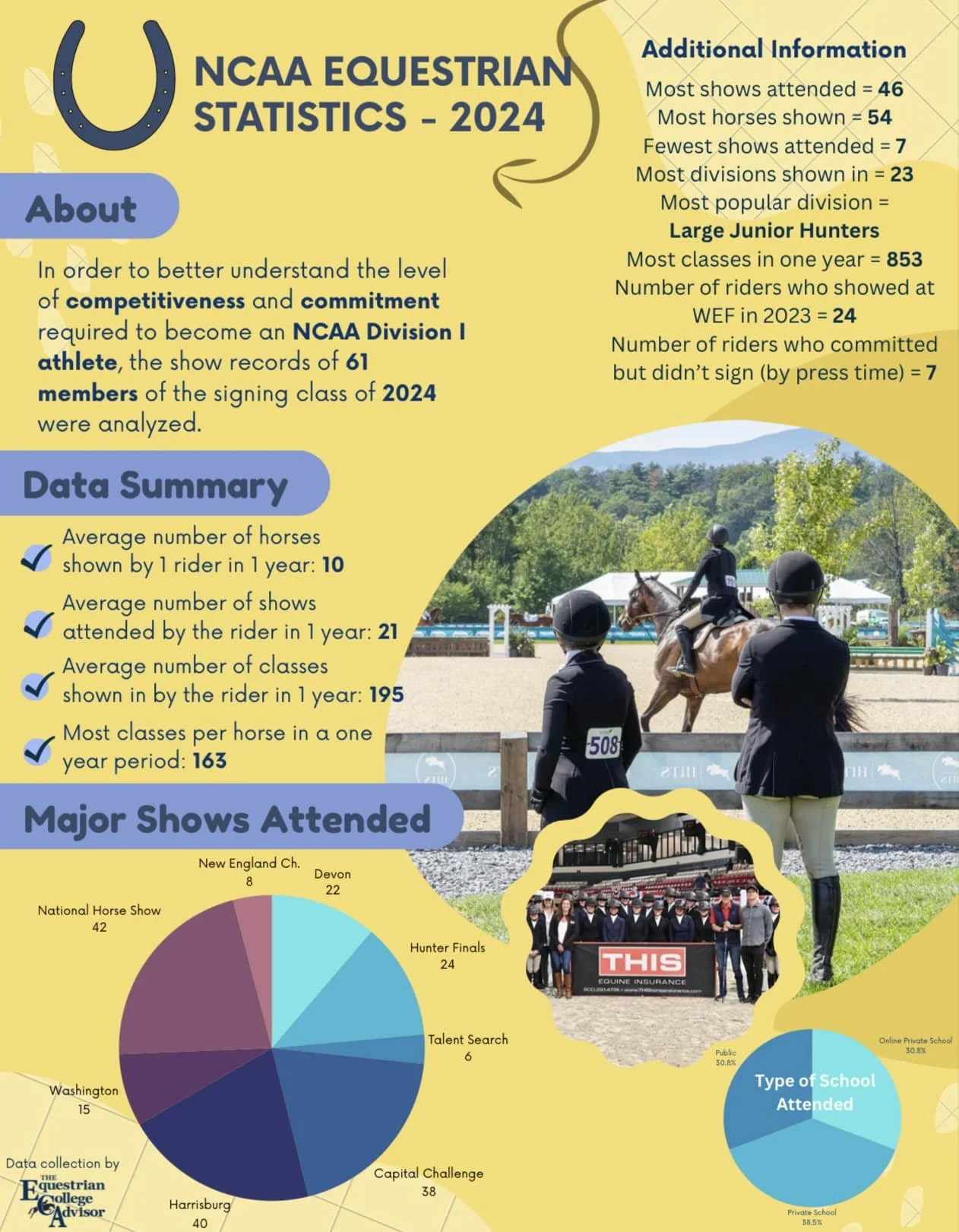
Source: The Plaid Horse Magazine Facebook page found here: https://www.facebook.com/photo/?fbid=790532356426572&set=a.238056661674147
The student athletes on these college varsity teams received significant financial support to reach their level of achievement. Even families with upper-middle-class incomes often cannot provide access to similar opportunities.
So, when I see these kids, who show at WEF and WEC, and go to year-end finals, and own multiple horses, competing over the 3’, I don’t see how this isn’t a social club. The level of competition for many is a joke. And to be clear, I do feel bad for the kids of UC Davis; they do work hard, they are deserving, and they benefit just as much as any other athlete from being on a team, but I don’t see how being on the club team wouldn’t give them that same experience.
And for my last point. Addressing the lost-opportunity arguments, supporters of the program are raising. Including the loss of scholarships, the opportunity for more people to get into equestrian sports, the loss of a pipeline into “equestrianism” as a profession, and what these kids will do after the program ends.
Not to beat a dead horse, but most of these kids do not NEED the scholarship. Everyone likes to save money, but tuition to UC Davis, especially in-state, probably costs less than or the same as one winter show season. Giving scholarship money to kids who need it to even attend college is likely the school’s priority and is likely factored into the decision to get rid of the team. Another argument is that this is a way to get more people into sport. It absolutely is not. Now, that argument might be more applicable to the Interscholastic Equestrian Association or IEA teams where you can get sponsors and donations to support the teams and, I would be (leave a comment if you know for sure) that to qualify and join the team and compete, that you don’t have to have the show record you might to get on the NCAA teams.
Another lost opportunity people were griping about was that this is a pipeline to professionalism for these athletes. Many athletes (as in other sports as well) never plan to go pro after college. If you're good enough to be a professional athlete, you don’t “play” in college; the level of play is too low. I know this is a bit contradictory to my argument that the level of play for the NCEA teams is low but, there is a big gap between being a pro rider and starting in the lower grand Prix’s, riding in the international hunter derby or, going home and starting and training young difficult horses and the 3’ simple hunter/eq courses at the varsity athlete level. If you are going pro, this doesn’t teach you much.
To wrap up my last point, these athletes will keep showing like they were, a few will actually go professional, likely the ones that don’t need a real paying job and can afford to ride for another trainer for free or pennies on the dollar (cause that’s how that works). Most will join the club team and compete all the same, just without the title.
To wrap things up, I know people said that this team was doing well, that they were placed 7th in their division. So let's put that into perspective. On the NCEA website, it says there are 28 total NCEA (NCAA) teams, of which 21 are DI. Being 7th is putting them in the top third, which is good, but is that really as impressive as they make it sound? I don’t think so. In a Fox News interview linked below, the team said it was funded for the next two years with private funds. Varsity teams are funded by the University, while club teams are self-funded. This tells me that financially, the team wasn’t sustainable.
In conclusion, I feel bad for the athletes, I bet a lot chose that school for the equestrian team but, based on the data, these aren’t the kids that are going to lose access to the sport, keeping this team isn’t going to help increase access to the sport to a more diverse group of people and, dollar for dollar in scholarship opportunities, funding sports with less overhead is more equitable and more in line with the Title 9 mission.
Student athletes who can afford to pay $300/hr for “educational consulting” to help get them on an equestrian team (seriously, it’s a thing, Google “The Equestrian College Advisor”) aren’t the ones who need scholarships and a literal leg up in life.
The Equestrian College Advisor https://equestriancollegeadvisor.com/index.html
So, I support UC Davis; they did the right thing and the equitable thing.
Thanks for reading.
Related Article:
What the Loss of UC Davis’s NCEA Division I Equestrian Team Means for the Future of Our Sport
UC Davis equestrian team looking its varsity status
https://fox40.com/video/uc-davis-equestrian-team-looking-its-varsity-status/11429221/